
View over Ghent
I'm very sorry for the delay between posts. I've been a slacker, but it sure has been nice to spend the evenings relaxing in front of the TV and then going straight to bed!
We realized today that this is the longest we've ever been on the road, and we are so ready to be settled in our new home. Sightseeing is wonderful and we're very thankful to be able to do so much of it, but it will be nice to keep it to a few days a week once we live here! We still can't believe we'll be living in Europe soon.
Anyhoo, on Wednesday we took a day trip to Ghent, which is just over a half hour east of Brugge. David decided to drive instead of take the train and it went very well. He is getting used to the wrong-side thing and the roads have been even better than expected - most of them very wide and smooth. And most importantly, they have been far more empty than expected! This is especially surprising since our guidebook says Belgium is the second-most densely populated country in Europe and the drivers are aggressive.
Ghent was very nice and we have difficulty deciding whether we like it or Brugge better. They are similar in many ways - about the same size, with cobblestone streets, multiple large churches, and canals throughout the city. But Ghent seemed to be more lively than Brugge, less touristy (we seemed to be almost the only ones there!), and had many more shops. Sadly the weather was so cold and so grey that all our outdoor pictures are pretty lame, so this is just a small selection of the highlights.

A canal in Ghent
Our first stop was Sint-Baafskathedraal (St. Bavo's Cathedral), which is 14th-century Gothic with an older Romanesque crypt underneath. Photos were not allowed inside, but we took a few anyway, of course.

Approaching the cathedral, with monument to artist Jan Van Eyck on the right

Huge Baroque pulpit (most pulpits seem to be like this in Belgium)

This is the star attraction inside the cathedral: an altarpiece called The Adoration of the Mystic Lamb by Jan van Eyck (completed 1432). We didn't take this picture; photos were very strictly forbidden. In fact, you had to pay €3 to enter a small room where it was protected behind glass, but very well-lit and low enough to get a good look. It was very impressive indeed, especially the details in the people's faces. It's also quite a unique scene, with the Lamb on an altar against a Flemish landscape. You can look at it in more detail here.

You could gaze at this Rubens painting in a side chapel for free, and David was able to capture this lovely detail of it.

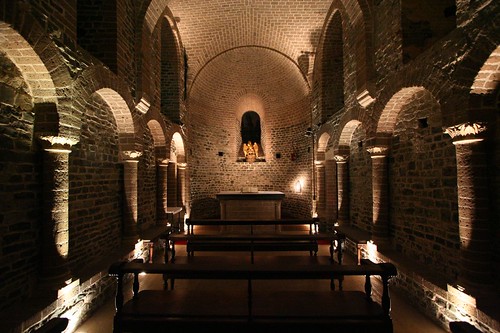
Stairs to the Romanesque crypt. This was the highlight for us, as there was no one to see us taking pictures and it was filled with medieval frescoes! Hooray! It also seemed to serve as the treasury, with lots of silver reliquaries, robes, manuscripts and such in glass cases.

Frescoes in the crypt

Fresco of a monk with a funny expression. I think he might be St. Francis.
Next stop was St-Niklaaskerk (St. Nicholas' Church), which is very close to the cathedral. I thought it was prettier on the outside than the cathedral, and we were allowed to take pictures on the inside. It had nice tall pillars, a little ambulatory where you could walk behind the huge Baroque altar and a few fragments of frescoes high on the ceiling.

View from the castle (more on that below!)

Flying buttresses on the east end


Ceiling in the ambulatory, with bits of frescoes

Back of the Baroque altar, featuring a sculpture of God "breathing the hot wind of judgment down on the world." That's one I haven't heard before.
Then we wandered down the main shopping streets, where we were diverted by an electronics store for awhile. David led us in, but it turned out to be mighty fun for me too. In the back corner of the store were the big flat-screen TVs. On one wall they were playing a video of aerial views of castles and cathedrals in Belgium - so beautiful. My website would be seriously awesome if we had our own helicopter! And then on the other wall they were playing Casino Royale, specifically the part where Daniel Craig is lying on the beach. I must have looked like I was at a tennis match as I stood in front of them.
Later, a pleasant canal-side walk led us past the large St Michelskerk (which was locked) to the Gravensteen, a cool castle built by the Count of Flanders in the 12th century.

The Gravensteen, with a canal for a moat

Spooky eye-like windows
The castle is partially ruined, but still has enough roof left (or replaced) that there are many rooms to explore, including a museum with antique weapons - some very beautifully decorated - and cringe-worthy instruments of torture and execution.

Main hall


Maiming and killing with beauty and style.
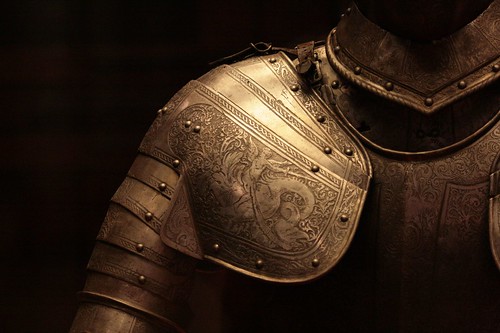
Detail of a knight's armor

Cellar, also used as a dungeon

On top of the castle, nice views of the city could be had.
Thursday: Day in the Netherlands, Evening in Brugge
Yesterday, we took a drive north into the Netherlands. It's not far away at all, and thanks to the European Union we hardly noticed when we crossed the border. There's just a small sign on the side of the road to mark the spot. We were in the region of Zeeland, which is the westernmost part of the country and runs along the coast north of Belgium.
We didn't have any major goals on the drive, just a couple towns that David wrote down because they were on the coast. It was very interesting to see some Dutch countryside - we didn't see much of it when we visited Amsterdam and Leiden. We generally liked what we saw - flat landscape, canals everywhere, and wide empty roads. Not as many windmills as you might expect, but each village seemed to have a big old windmill to go with its church tower.


We pulled over at a couple random churches, including the above, but it was raining so hard that we didn't linger long.
Our main stop was at Terneuzen, which is clearly not a tourist town but seemed representative of the region. We wandered up and down the streets for a bit and found excellent lunch in the form of a hot ham-and-cheese croissant (with sharp Gouda giving it more zip than usual) for me, a Mexican roll (French bread with taco meat and cheese) for David, and a side of delicious St. Nicholas Mix - peanuts, cashews and dried fruit.
Then we drove back to Belgium and parked on the east side of Brugge to do some evening sightseeing and find dinner. The main sight we got to before closing was the Jeruzalemkerk, which turned out to be very cool. David was especially enthusiastic about it, thanks to its uniqueness.
It was built in the 15th century by a local rich family after one of them returned from a pilgrimage to the Holy Land. It is patterned after the Church of the Holy Sepulchre in Jerusalem, with a large round tower. It even includes a replica of the tomb of Christ, with a statue of Christ still in it.

Exterior

Main room, from the entrance

Room behind the altar on the same level, with entrance to the "tomb"

The "tomb of Christ," which you have to really stoop over to enter. Although moderately kitsch with the statue of Christ, it was really quite atmospheric.
From there we walked into the center of town, which was looking very pretty in the evening light.


We had a nice hot dinner from the Christmas market in Markt Square, which felt much more lively and festive than it had during the day.

The Belfort (belfry) by night, overlooking Markt square


I chose a dish made of potatoes, bacon, brie cheese, butter, white wine, mustard, and spices. It was good but a little strong-tasting for me - not sure if that was the cheese or the wine. It was sure impressive to look at, though - they always had one huge pan of the freshly-sliced ingredients (left) and one pan of the blended result.

For dessert, we finally had our first hot Belgian waffle. Interestingly there were two kinds (click to enlarge for a better look): one that was sweet like I described previously and one called a Brussels Waffle that was not as sweet and a bit more like the American version. I had the former with whipped cream, David had the latter with powdered sugar. Both delish.
Today: More Brugge
Today we didn't feel like doing anything too ambitious and the weather continued to be bad, so we just made a short excursion into town. We parked in our usual Biekorf parking garage, which is quite easy to use and not too expensive.

I loved these instructions for the parking garage - so cute, multilingual by nature, and even includes a visit to the Belfort.
The first order of business was lunch, which we had at a bakery-cafe recommended by our guidebook called Het Dagelijks Brood ("The Daily Bread"). Despite being very close to the Markt, it wasn't the least bit touristy. There weren't any English menus (which we've had everywhere else) and our waitress' English was a bit more hesistant than some.

Everyone around us at the large communal table spoke Dutch, except for one couple who spoke French - but then they met up with another couple and spoke Dutch with them. The mastery of languages in this part of the world is truly astonishing. We are so very jealous and vow to do our best to at least become competent in German (and I want to be fluent in French too - despite three years of high school French I have so far to go).
The menu came in Dutch and French and we did our best with the French. I could translate most of it except for a key word - tartine - which was the main sort of thing they served. Since there had been quiches in the window and we saw those nowhere else on the menu, I thought tartine might be another word for quiche (it does sound like tart, after all). Wrongo, but we ordered based on that - me a ham and cheese version and David the tuna and hummus version.

It turned out tartine is far from being a quiche, but in fact we liked it much better. It was meat, cheese and veg laid out delicious slices of nutty bread. Relatively healthy, very filling, and very delicious.
After lunch we headed for the nearby Basilica of the Holy Blood to take those pictures of the lower basilica I'd missed last time. The lower part is Romanesque, my favorite as you know.

Carving of the Baptism of Christ
Next we visited the Groenige Museum, which was smallish but very well laid-out. It had a nice collection of Flemish art, mostly paintings that were once in churches. There were several paintings by Jan van Eyck and one by Hieronymus Bosch, one of our favorites because he paints some real strange stuff!
In the vicinity of the museum were some of the prettiest canal scenes we'd come upon in Brugge.

This is the oldest bridge in Brugge, from the 13th century. The tower is part of the Onze Lieve Vrowekerk, which we visited our first day in Brugge.


This cute chocolate shop is the one recommended by most guidebooks, including my own. We gazed in the windows at on the way back to our car but we've been having lots of treats lately and the tiny shop was rather full, so we resisted buying anything.
This evening we relaxed in our hotel, ordered room service for dinner (it's surprisingly inexpensive for simple dishes like pizza or a grilled sandwich) and watched the movie Fracture on the laptop. Good stuff! And then I finally stopped procrastinating and wrote this blog post.
Tomorrow: Germany!
We are so excited to be living in Germany starting tomorrow!! We will probably leave here around 11 or so, then make the three-hour drive to our new home in Bonn.
Sadly we will probably not have internet access tomorrow night, and perhaps a day or two beyond, as I think we need to set it up ourselves. David will certainly be on it immediately, but it might be a bit complicated, especially with it all being in German! But we'll do our best to get connected and I'll post an update as soon as I can.
Auf wiedersehen until then!


