Tuesday, January 29, 2008

A Day at the Museum in Bonn

Last Thursday was a gloomy day weather-wise but we felt like going somewhere and taking pictures, so we drove into Bonn to check out the Rheinisches Landesmuseum (Rhineland Regional Museum). It was FANTASTIC.

The museum is in a very modern, brightly lit building (opened in 2003) and focuses exclusively on local exhibits from all time periods, which are divided into themes. And lucky for me, their most extensive collection was in the religion theme! There were ancient Germanic burial monuments, bunches of Roman altars and gravestones, several Early Christian gravestones carved with the Chi Rho, wonderful Romanesque carvings from Cologne churches, paintings... I was in heaven.

from many gods to one god Pictured at right is the title of the religion section. Sadly this was pretty much the only bilingual sign in the museum. I spent a couple days after our visit attempting to translate the German museum labels in order to caption our photos. It was a bit of a tedious process, but of course I was interested to learn about all the stuff anyway.

You can see some of the best treasures with full captions on my article on the museum, or check out the photo gallery. Even that only scratches the surface, as I still have a good hundred more photos to work through!

Some highlights (click on photos for much more detailed captions):

three magi
Three Magi from a Romanesque choir screen near Cologne (c.1150).

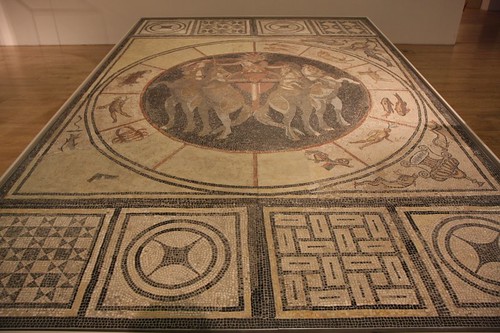
rheinisches landesmuseum, bonn
An impressive floor mosaic from a 3rd-century Roman villa. In the center is the sun god (who was especially popular in this period) with his chariot, surrounded by the signs of the zodiac.

aquarius (wasserman) cancer the crab (krebs)
A rare (in Germany) and beautifully carved depiction of the signs of the zodiac, which decorated a lot of medieval churches in France. This is Aquarius and Cancer. Note that Cancer doesn't look much like a crab - medieval Scorpios rarely look realistic, either. Both tend to look more like lobsters.

chi rho with alpha and omega
Chi Rho (first two letters of "Christ" in Greek) on a beautifully carved gravestone from the 6th century AD.

gravestone of meteriola (5c)
Detail of a Christian gravestone of the 5th century AD. The deceased's loved ones clearly didn't have the money for a professional engraver like the one above.

pfalzfeld column alien? on pfalzfeld column
Creatures that look like a cross between Snoopy and an alien, decorating a burial monument from about 500 BC.

eyes of st. ottilie
Eyeballs! This is St. Ottilie, who was born blind but healed through baptism, and is the patron saint of eye diseases.

moselkern stele (7c) madonna and child
A mysterious stone from the 7th century and a lovely Madonna and Child.

last judgment triptych (16c)
A fairly innocuous-looking painting of a rich family, but if you walk up to it and look close...

the condemned (16c)
...there are some very interesting details! As you might guess, these are the unlucky ones at the Last Judgment.

grave mosaic of abbot gilbert (12c)
A happier scene to end on: the mosaic gravestone of a friendly-looking Abbot Gilbert, first abbot of Maria Laach.

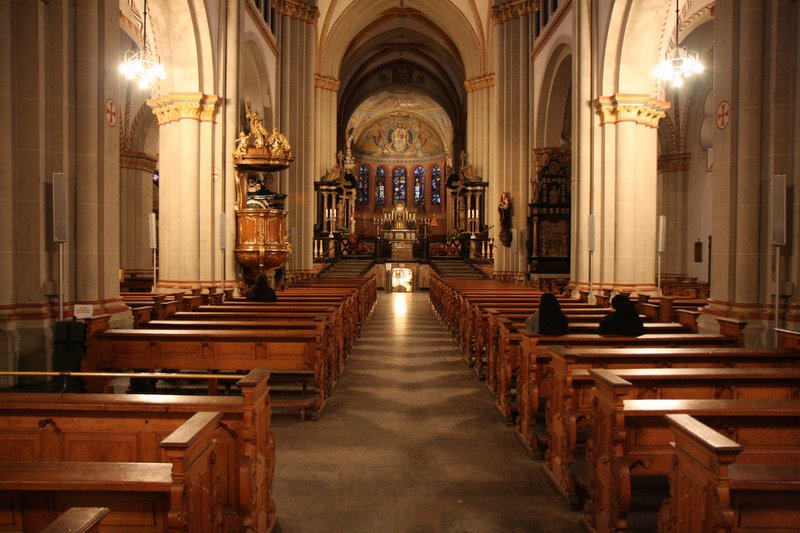
After the museum we stopped briefly in Bonn Münster to try out the new lens in its very dark interior:

bonn museum
It did well.

bonn museum
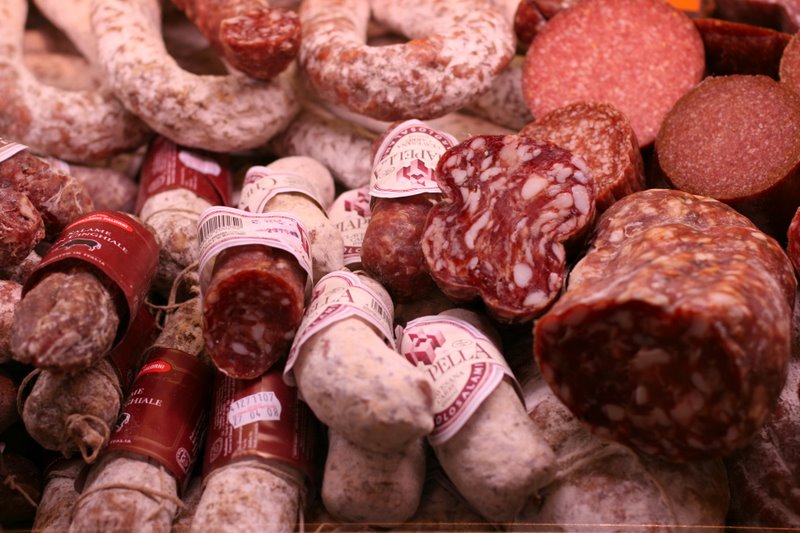
Then we picked up some groceries in our new favorite store in the Galeria basement, and I took a picture of sausages. There are a lot of sausages in that store. And every other store in Germany!

we heart seafood
For dinner that night we had fresh seafood cooked in our heart-shaped pie pan. The scallops were especially divine! At the store I had been delighted to learn that the German word for scallop is Jakobsmuschel, reflecting the scallop's role as symbol of St. James and pilgrims to his shrine in Santiago de Compostela.

Monday, January 28, 2008

Maria Laach Abbey

Over the last couple weeks we've made two visits to Maria Laach, which happily is just a 30-minute drive down the Autobahn from our home in Bonn.

maria laach abbey

Maria Laach is a little lakeside resort that centers on a magnificent Romanesque abbey church. I learned about the church only recently, in my Oxford History of Early Medieval Architecture (a wonderful book, by the way), and was really looking forward to seeing it. With its lakeside location and monumental size, it surpassed even my high expectations.

lake
The beautiful Laacher See or "Lake Laach." Laach is the Old German word for lake and the abbey was named for it. But See is the modern German word for lake.

Laach Abbey was founded in 1093 by Count Heinrich II von Laach and his wife, who lived in a castle across the lake. They couldn't have children, so they donated their inheritance to building a monastery on the opposite shore. It was finished by 1167 and became rather important in the Middle Ages. After lots of turmoil and occasional closures under Napoleon, the Prussians, and the Nazis, the abbey is once again home to Benedictine monks.


The first time we visited (Sunday Jan. 13) we arrived just after sunset so our pictures weren't very good. It was also mighty cold out, but we were still impressed by the church and enjoyed our visit a great deal.

On our second visit (Wednesday Jan. 23) we arrived around noon, which gave us the opportunity for some good sunbreaks and enough time to explore the area more thoroughly. It was a wonderful day out. There was, however, one significant downside, photo-wise...

maria laach abbey
Wouldn't you know it, in the week since our first visit they put up scaffolding on half the front! Signs said it would be there until the end of 2009. Arggh. What a bummer. The restorations (although I'm sure necessary) are especially unfortunate since this west porch/courtyard is one of the most unusual features of the church.

maria laach abbey
The white building on the right is part of the abbey where the monks still live.

maria laach abbey
View from the side (northwest). What a stunning example of Romanesque architecture, with its variety of shapes coming together into a harmonious whole. As the aforementioned Early Medieval Architecture book puts it:

"The Benedictine abbey church of Maria Laach (1093-c.1250) is one of the more spectacular monuments of Romanesque Germany, its broken silhouette of towers and turrets conveying the impression of a romantic fortress rather than a church."

maria laach abbey
Colorful details over the entrance to the west porch.

There is a great collection of interesting carved capitals and friezes around the west portal and inside the porch, featuring mythical creatures and some rather odd scenes.

devil(?) with crack
Here's the buttcrack of a wrestling boy and a devil taking notes (a list of sins?).

wrestling
The wrestler with his opponent. I don't see any feet - maybe they are mermen?

frieze
capital
capital

maria laach abbey
Interior view. Note that there is a whole lot of wall and only small windows, which is one of the main characteristics of Romanesque architecture.

vault
Original Romanesque groin vault in the nave

After our church visit we got to go on some short nature walks!

david at maria laach
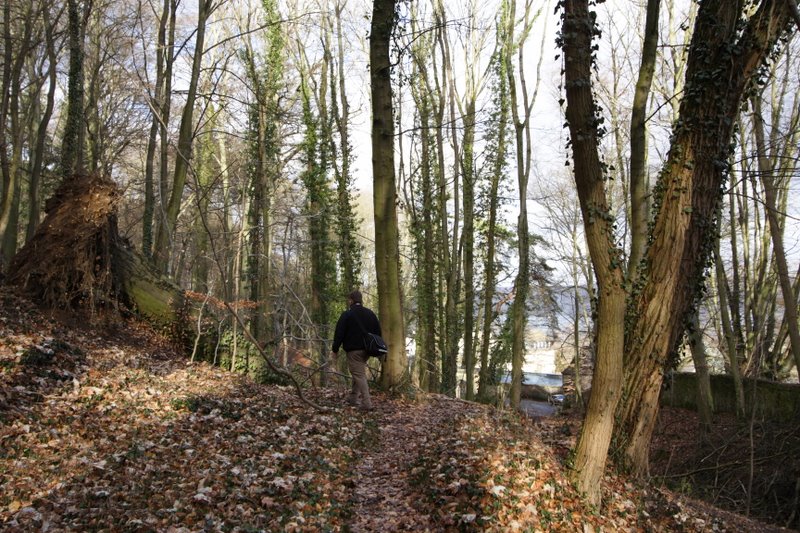
First we headed up a trail behind the abbey that led into a nice little forest complete with logging roads and leafy paths.

maria laach abbey
We had a nice view of the abbey through the trees.

maria laach abbey
This is the St Nicholas Chapel, which is also from the 12th century and prettily painted. It's on the abbey property and sadly not open to the public. Unfortunately there is also a tall stone wall between the forest and the abbey so we risked life and limb climbing on large rocks to get the above views.

Then we made the short walk to the lake, which is just down a paved trail from the parking lot. Both times we've visited, the lakeside walking paths have been full of people out walking. We are continually impressed with the Germans' commitment to outdoor exercise. The paths near our apartment always have people walking on them, many of them elderly, in all kinds of weather.

nordic walking technik
Next to the parking lot (a fairground-type affair on grass and mud) were thorough signs with instructions for mastering the Nordic Walking Technik. This technik is clearly very popular, as the vast majority of walkers we see have their sticks along.

walkers
A fit-looking pair with their sticks.

maria laach
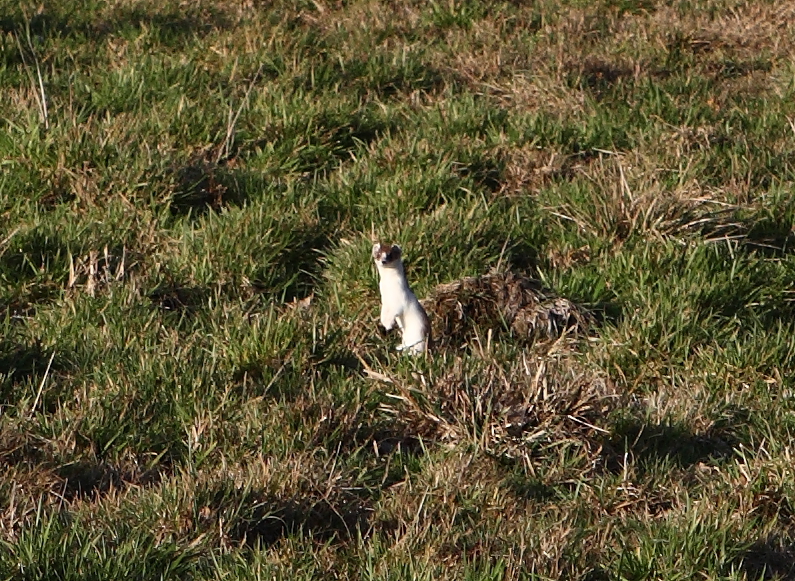
On our way to the lake we saw an ermine! I don't think I've ever seen one before, although they are apparently common throughout North America and Europe. He is so cute. The poor picture quality is due to a very long zoom - he was only a little white blur in real life.


View south from the trail to the lake. The Laacher See is a crater lake formed by a volcanic eruption just 10,000 years ago and this whole area is covered in volcanoes. Maria Laach is in the middle of the protected "Vulkanpark" (which has excellent walking trails). They are still active, too. Gulp.

Maria Laach Abbey
On the shores of the Laacher See. It's very blue, a bit like the famous Crater Lake back in my home state of Oregon.

winter lake
The lake shore.

Maria Laach Abbey
A really big dog enjoying his evening walk.

ducks
Ducks in the fading light

See my article for lots more about the history and features of Maria Laach and the accompanying photo gallery for lots more pics of the church, its weird carvings, and the pretty lake.

Friday, January 11, 2008

Aachen

This week's excursion was to Aachen, which is handily located about 45 minutes directly west of Bonn, near the Netherlands border. Like Trier, we had visited it in 2005 but felt was well worth a re-visit. The weather was generally grey and cold as usual (what is this, winter?) but fortunately nearly all of the attractions were indoors.

The Aachen trip was the first real test of our new camera and new lens, and they performed very well! Pictured at right is David with his "old" zoom lens on the new camera body (Canon 40D). I used David's old camera (Canon 400D) with the new 50mm prime lens and also carried my standard wide angle setup (Canon 350D). We had such fun.

Aachen has been popular since Roman times for its natural hot springs (the hottest in Northern Europe, apparently). But it really found fame when Charlemagne ("Karl der Grosse" to the Germans) took a liking to it and made it his capital. He built a palace there, which no longer survives, along with a "Palatine Chapel," which survives fully intact as the heart of Aachen Cathedral.

aachen cathedral
The round part in the top center is the Palatine Chapel, with later stuff tacked on all around it to make it into Aachen Cathedral.

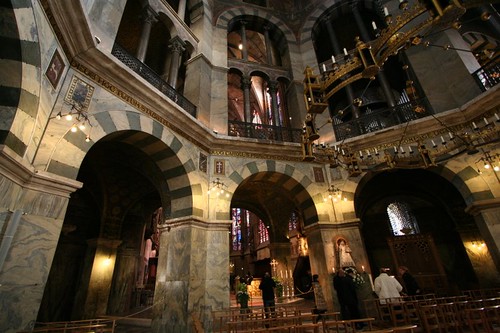
This venerable history means that Aachen Cathedral is exceptionally old and very unique. The chapel was built in 786 AD to a design inspired by the Church of San Vitale that Charlemagne had seen in Ravenna, Italy, which are also still there. It has an octagonal shape, striped arches, and a ceiling covered with (modern) golden mosaics, all of which give it an exotic, eastern feel.
aachen cathedral

Aachen Cathedral is also known for its incredible collection of treasures, which sure impressed us. Most of them are made of gleaming gold, which presented a good challenge for our upgraded cameras (and the new skills required for operating them!).

There are six big treasures (by my count) in the cathedral itself, and we joined a guided tour in German so we could have closer access to all of them.

tour guide
Our tour guide. He spoke fast and we didn't understand a word he said, except for "Barbarossa," "Karl der Grosse," "Byzantinisch," and a few assorted numbers. We really need to devote more time to our German studies.

Treasure #1: The Golden Pulpit, which dates from around 1020 and was commissioned by Emperor Henry II. It is covered in gold and studded with jewels - and big ancient bowls! Besides the dishes are other unusual decorations: rather sensuous pagan Egyptian ivory panels from the 6th century AD. It definitely wins the prize for most interesting pulpit so far.

aachen cathedral
golden pulpit
aachen cathedral aachen cathedral

2. The Golden Altar or Pala d'Oro, which also dates from around 1020.

pala d'oro (c.1020)
pala d'oro (c.1020)

3. The Marian Shrine, containing the impressive collection of relics obtained by Charlemagne during his lifetime.

marian shrine

There are just four relics in there, but they are biggies:

1. The cloak of the Virgin Mary;
2. The swaddling-clothes of the Infant Jesus;
3. The loin-cloth worn by Jesus on the cross;
4. The cloth that wrapped the head of John the Baptist after his beheading.

Impressive, eh? These relics attracted thousands of pilgrims in the Middle Ages, and some still trickle in today. They are taken out and shown every seven years - the last time in June 2007. We just missed it!

4. The Shrine of Charlemagne, which contains his remains. Charlemagne became a semi-saint (never officially endorsed by the pope) thanks to the promotional efforts of Frederick Barbarossa in the 1160s. Charlemagne was originally buried somewhere in the cathedral, but Barbarossa had him exhumed and spread the rumor that he was found miraculously sitting up with his crown on his head and a Bible open on his lap. Then he had his bones placed in this specially-made golden reliquary.

aachen cathedral
aachen cathedral

These house-like golden shrines are a lot like our Shrine of the Magi in Cologne Cathedral, pictured below, which was made around the same time (1180-1230). The Cologne version wins out for biggest and best, I think.

cologne cathedral

5. Barbarossa's Chandelier, which was commissioned by Barbarossa for the occasion described above. It was made in 1165-84 in Aachen; its towers represent the Heavenly Jerusalem as envisioned in Revelation.

aachen cathedral

It is huge (4.2m diameter), and I seem to recall reading somewhere that it pulled the whole ceiling down when it was first installed. This may be the reason for the replacement ceiling mosaics!

chandelier of barbarossa
Our new camera-lens combo is so sharp that we can clearly see they need to dust!

6. And finally, in the upper gallery and accessible only a guided tour, Charlemagne's throne can still be seen in its original position. It is made of simple marble slabs held together with bronze clamps. It was used in coronation ceremonies by all Holy Roman Emperors after him.

aachen cathedral
throne of charlemagne

Tacked onto Charlemagne's chapel is a Gothic choir (added in 1414), where the two golden shrines are displayed. It has the tallest wall of stained glass I've ever seen.

gothic choir, aachen cathedral
All the glass is modern, but at least they've used nice jewel-tones to recreate the original effect.

aachen cathedral
Trying to get artsy with the 50mm prime lens and a processional cross.

our lady of aachen (14th cent.)
This is Our Lady of Aachen, who was made in the 14th century. I love the expression on the baby Jesus - doesn't he look like a naughty little boy??

Then there was the Treasury itself, which is located down the street and around the corner. It was full of great stuff, including more gold reliquaries, Charlemagne's hunting knife, early medieval ivory carvings (which I especially like for their delicate detail), various altarpieces, and the like. Here's a few of my favorite things:

aachen cathedral
aachen cathedral
A silver book cover from 1170, with a Byzantine ivory panel that's significantly older.

lothair cross, detail
The Lothair Cross, which is still used in processions at the cathedral. It was commissioned by Emperor Otto III (993-1002). It's covered with gold and jewels like everything else in Aachen, but in the center is something unusual: a cameo of the Emperor Augustus, carved around the time Christ was born.

aquamanile
This funny little man was cast in bronze and gold in 1215 in Aachen. He is an "aquamanile," a vessel from which water is poured onto a priest's hands as part of a symbolic cleansing during Mass. I hadn't heard of such a thing before, so that was interesting.

holy water vessel (c.1000)
A holy water vessel from about 1000, carved from ivory and studded with precious stones.

After all this excitement we had a delicious lunch right next to the cathedral at a place called Nobis, which we highly recommend should you ever find yourself in Aachen.

lunch at nobis, aachen

It's a casual bakery-restaurant, the sort of thing done well all over Germany, but our sandwiches were exceptional...

lunch at nobis bakery
(That's cheese cooked into the roll.)

...and they are known for making the best version of Aachen's local specialty, a gingerbread cookie called Printen. They get their name from the former practice of imprinting them with an Aachen logo.

lunch at nobis, aachen
printen dough rolling printen

We bought a bag of those with assorted toppings and we are seriously considering going back to Aachen just to get more! It's a soft but very chewy gingerbread cookie, with some kind of spiced hard sugary stuff (it's a secret recipe) in the center. Not too sweet; just perfect.

On our way home there was some lovely evening light that we would have really enjoyed in Aachen, but I made do with the subject that was available:

industry
Most of the drive between Aachen and Cologne looks like this. And also between Bonn and Cologne. But it has its own beauty, I suppose.

Cologne

David took a solo trip into Cologne yesterday, mainly to wander around electronics and camera stores, and he had a very nice time. He took a camera along and brought back some fun shots:

cologne
Tram

cologne
Guy sleeping in Ikea

cologne
Cheerful sculpture

good listener
Good listener

hauptbahnhof
Main train station

The rest of the week we've mostly stayed at home, with David hard at work on mastering Photoshop and related things and me working on a big project on Canterbury Cathedral's stained glass windows, along with a general photo gallery of the cathedral, for Sacred Destinations. I still have a bit more to go, but it should be published soon! Then I'll get lots of photos of Aachen's magnificent treasures ready for publication as well.