
Above: Toledo Cathedral from the tower of a nearby church.
Toledo certainly lives up to its usage in the popular expression - there are so many great religious sights there that we would need a week to see them all properly. But in our six-ish hours there, we managed to squeeze in a huge cathedral, a monastery, a Jesuit church, two synagogues and a mosque. And we also made a couple stops in knife shops for David, who was in heaven with the wondrous variety and quality of the famed Toledo steel!
After finally getting rid of our luggage (see last post), we hired a taxi outside the bus station, asked him to take us to La Catedral, and enjoyed the 10-minute ride up into Toledo's old town. The city is all perched up on a big rock, around which runs a river on three sides. So the scenery was quite breathtaking, with rocky outcroppings partially covered in grass and trees and lots of deep gorges. At the top was the city itself, very picturesque with its red roofs and warm-hued buildings.
 The journey became even better as we neared the cathedral - the one-way roads were so narrow that the car threatened to scrape the walls of houses on both sides!
At one point, a pedestrian tried to let us pass by squishing herself up against the wall, but our driver had to motion for her to walk ahead and get into a doorway - she would not have kept her toes otherwise! It was such a cool experience and I'm disappointed my picture did not turn out better, but you can still sort of see how close the walls are.
Toledo Cathedral
Our first stop was naturally Toledo Cathedral, a massive Gothic building constructed between 1227 and 1493. The exterior is virtually impossible to see in its entirety thanks to both its size and those narrow surrounding streets, but if we had the time to find the right vantage point and stay until dark, it would look like this:

Photo by Ramón Durán.
But from ground level, you can still enjoy the portals and tower, both of which are beautifully carved and shaped. And after paying the rather steep admission fee of €6, we were able to see the interior which, in contrast to the bareness of Segovia Cathedral, is absolutely filled to the brim with furnishings and art masterpieces. And tour groups!
Happily, photos were allowed, and we spent about an hour and a half in there, gawking and snapping away at magnificent carved choir stalls, opulent side chapels, huge altarpieces, museum treasures and colorful stained glass windows. The best parts are the Coro (choir), which is the most spectacularly carved choir I've ever seen, and the Capilla Mayor (Main Chapel), with a huge Baroque altarpiece. Below are only a few highlights of what will eventually be a very large photo album on Sacred Destinations.

Capilla Mayor (main chapel) in the center of the cathedral


Views in the side aisles, including a giant mural of St. Christopher.

The magnificent Coro or choir, my favorite part of the cathedral. It was carved in the 15th and 16th centuries.

The wooden stalls of the choir have two tiers: the main one you see here depicts the conquest of Granada (by Catholics from the Moors) a village at a time, and was carved in 1495. Above that are people and scenes from the Old Testament, carved in 1543. Topping it all off are alabaster carvings that contrast beautifully with the dark wood.


Beneath every seat are misericord carvings, with their usual odd and comical scenes of jokes and everyday life. Most are worn smooth from the centuries of contact with clerical bottoms.

A colorful Pieta scene, part of a gated altar behind the choir


Pretty rose windows above the north, west and south doors


An incredibly huge and very Gothic altarpiece in the Capilla Mayor (above left), and two views of the Baroque El Transparente in the east end (above middle and right). Enlarge the far right photo and look for red hats hanging from the ceiling - those belonged to the cardinals who are buried in the tombs seen in the center photo. They can pick anywhere in the cathedral to be buried, and their hats are hung above them until they (the hats, not the cardinals) rot away.
Sharp Objects
After the cathedral we came upon a great knife shop, where David was like a kid in a candy store. After some window shopping, we went inside where I was happy to warm up and browse while David talked with the shop owner (a rare English speaker) and handled some knives he'd only ever seen on the Internet.
If it weren't for our limited time, shipping and VAT issues, and the fact that most knives are illegal in Britain (except for kitchen knives, which people stab each other with just fine), we would have left with a couple!
Synagogues of Toledo
Our next stop was to Toledo's two wonderful synagogues, which were converted into churches after the Catholic monarchy kicked the Jews out of Spain in 1492. Fortunately, however, the original architecture was almost completely preserved and they are great examples of the unique style of architecture from Andalusia (southern Spain), which can be found from Toledo all the way down to Morocco.
 Andalusian architecture developed from the blending of civilizations that successively occupied this area - first was the Visigoths, "barbarians" from the north who were Arian (heretical) Christians and are credited with inventing the horseshoe arch. They were followed by several successive Islamic dynasties, who brought their own Arabic and North African influences.
After the Catholics took over in the 15th century, a few mosques and buildings from earlier eras survived (such as these synagogues), but the art also lived on through the Muslim converts or pseudo-converts who stayed in Spain and decorated churches and other buildings. Work by such artists is known as "Mudejar." This mixing of Visigothic, Islamic and Catholic styles shows up again and again throughout our trip, and I found it to be very beautiful and unique.
The first Toledo synagogue we visited was Santa Maria la Blanca, which is obviously the name it was given after it became a church. The "La Blanca" part comes from the white arches that dominate in the interior. The synagogue was founded in 1203 and was designed by Moorish (Mudejar) architects, with the result that it looks much more like a mosque than a synagogue. We both loved it.


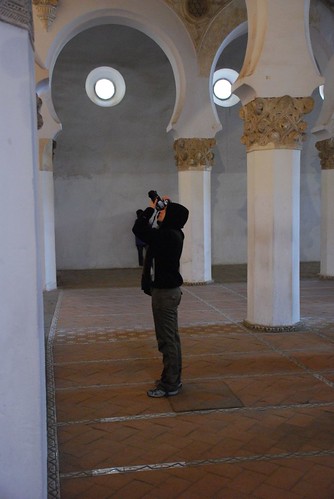


By the way, my hood's up in the photo above not because of any rule to cover heads, but because it was so darn cold! It was ridiculously cold outside, and it was rarely any better inside the various sights because they are mostly made of stone and aren't heated (understandably). In fact, it was often even colder inside because of the lack of sun. Didn't we fly south to enjoy warmer weather?? We consoled ourselves with the thought that we were heading much further south that evening, surely it will be warmer then... (foreshadowing: not so much).
Just down the road from Maria la Blanca is Toledo's other medieval synagogue, which dates from the 14th century (200 years later) and is called Sinagoga del Transito.
This one is a lot different - instead of all the arches, it's just a large open room decorated with intricately carved walls and Hebrew inscriptions. The beautiful ceiling is said to be made from cedars of Lebanon, just like Solomon's Temple. Overlooking it all is a women's gallery, which also has beautiful carvings and provides nice views of the main room.


The synagogue also includes a small Jewish museum, which has medieval religious objects along with more ancient artifacts:


As a bonus, just across the street from the synagogue is a marvelous view across the river:

San Juan de Los Reyes
Next up is the church and monastery of San Juan de Los Reyes ("St. John of the Royals"), a Franciscan convent founded by Ferdinand and Isabella to celebrate a big victory over the Moors. They also planned to be buried here and decorated it accordingly, until they captured Granada and decided that was a more fabulous resting place.
The large church (photos prohibited but unenforced) is nice, but the highlight is the two-story cloister with central garden, orange trees and gargoyles. Sadly the weather turned gray at this point, so the pictures aren't as pretty as they could be.


The unusual gargoyles included a cat (left) and a... monk? Or a gnome?


One often-mentioned feature of this monastery is its unique decorative use of leg-irons on the exterior, which were (supposedly) used to imprison Christians in Granada during Muslim rule. We looked all over for these and never found them - we suspect they were beneath a large part of the building that was under renovation.
A Jesuit Church with Nice Views
From the monastery we began to make a general heading back in the direction of the bus station, although we still had a couple hours to spend before our 5:25 train to Madrid. Along the way we came across a large church, and of course we peeked into it.
It turned out to be a relatively new Jesuit church, which was nice but not terribly interesting. I turned around to head back out - only to see David buying admission tickets! He said we had to at least have a quick look around. I love the enthusiasm! So we did, and saw some nice, golden altars and religious artworks which were attractive against the white walls. It reminded me a lot of the Jesuit church I briefly ran into in Lucerne.

Then as we both tried to head out, the man at the desk insisted (in Spanish) that we go up the towers and would hardly let us leave without doing so. So we obediently trucked upstairs, and it was worth it! We had some very nice views of the cathedral, which is nearby, the Alcazar, and pretty much all of Toledo. It's where we took the picture at the top of this blog post.

The building on the left is the Alcazar, or castle of Toledo. Although we would have liked to see it, it was not as high a priority as other sights so we'll have to save it for another time.
Lunch and the Search for San Roman Church
 There was still more to see, but by this time we really couldn't ignore our growling stomachs anymore. Fortunately, it didn't take too long before we found some quick and filling sustenance. On the fairly major road of San Roman is a little shop that also sells warm baguette sandwiches of various kinds.
While David checked out another knife shop next door (incidentally not as good as the first one), I got us Diet Cokes and two sandwiches con queso. They were very simple - nothing but a baguette and cheese - yet quite delicious and gave us the energy to press on until our train time.
We found a lovely little plaza just up the hill and enjoyed a rare relaxing moment in between the high-speed sightseeing. It was wonderful.

The next goal was then to visit Iglesia San Roman, an old church which now houses the Museo Visigoto or Visigothic Museum. I had seen photos and learned about it for my website (click link above) and it looked really interesting. Our guidebook also called it "the most interesting church in Toledo."
Unfortunately, our guidebook (Rough Guide to Spain) also put it on the wrong side of the street on its map, and I didn't know what it looked like on the outside. So we spent the good part of an hour on a ridiculous goose chase in the area, asking several people, staring at the compass, and examining several churches that were not it. In the end, it was right around the corner from the Jesuit church and we passed it several times, thinking it wasn't it. D'oh! And it was closed anyway. Argh.
Mezquita del Cristo de la Luz
We had more luck with our final sight in Toledo, an interesting little mosque called Mezquita del Cristo de la Luz (Mosque of Christ of the Light). Why is a mosque named after Christ? Because, just like the synagogues, it was later converted into a church. The "light" of the title refers to a legend that after the Reconquista, an image of Christ was discovered hidden in the mosque - and it had been miraculously lit by a lantern throughout the centuries of Muslim rule. And why would an image of Christ have been in a mosque? Because the mosque itself was built over a Visigothic church (this part's not a legend).


Legends aside, the Mezquita is a fascinating little building. It is also one of the oldest Moorish monuments in Spain, having been built in the 10th century. Unfortunately it was under major restoration works during our visit, but at least we were still allowed in (for an admission fee).


It was frustrating not to be able to go all the way due to the construction, because we could just catch glimpses into the interesting apse (round part) and of great faded murals from its period as a church.


From the brochure that came with our tickets I learned that there was a nifty old mural of Christ on the ceiling of the apse, but alas it was completely out of sight. One consolation, however, was that admission to the mezquita included some peaceful little gardens off to the side as well as easy access to some nice views of a large city gate (Puerta del Sol) and over the northern edge of the city walls.


See the Mezquita del Cristo de la Luz Photo Gallery for all the good photos from this spot.
Adios, Toledo
 And it was from here that we began our descent from the old city down towards the bus station to collect our luggage. Then it was back across the bridge (right), and after a much longer walk than I remembered (a good 15-20 minutes carrying a backpack), back to the train station.
 We had some time to spare before our 5:25 train so we had a quick snack at its cafe, including fried calamari (like rubber) and fries (good), before getting back on the lovely train. We had an hour layover in the Madrid train station, which is pretty nice but the bathrooms aren't, and then it was off to Seville on the 7:00 train.
Next: Semana Santa in Seville


1 comment:
Hi!
I´m a toledan guy and I have enjoyed a lot with your post and with your blog. I have added it to my favourites.
Congratulations, well done!!
Post a Comment