1. Holy Trinity Church
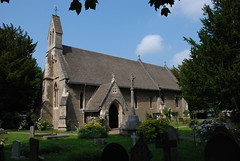
Our first stop was Holy Trinity Church in Headington, an eastern suburb/village of Oxford. The church looks old but is quite new by English standards: built 1849. It is normally locked, but thankfully they have just started opening from 2-5pm on summer weekends.

C.S. Lewis attended services here with his brother Warnie for 31 years, from 1932 until his death in 1963, and they always sat in the same pew near the back. There is a small plaque marking the spot.


Near the "Lewis pew" is the Narnia Window (above), which was added in 1991 as a memorial to two children of the parish who sadly died young. It features Aslan the Lion and lots of other characters and scenes from the Narnia books.
 A lady from the parish was there during our visit and we enjoyed chatting with her. (You can see us if you enlarge the photo at right.) She told me that now only one church member survives who attended at the same time as Lewis, but is too frail to attend services very often. The Lewis stories still circulate, though!
 Apparently he and Warnie always arrived early for 8am communion, then left early before the service was over. Lewis didn't like sermons, church music, or small talk.
 One popular anecdote is that every time the Lewis brothers would leave early, the door would slam loudly behind them. Finally the churchwarden decided to line the door jamb with rubber to muffle the sound. So the next time they left, it closed quietly behind them. But then when the rest of the congregation went to leave, the door wouldn't open! Someone had to climb outside through an old back door, walk around to the front and shove it open with great effort. They took the rubber off again, and had to go back to the slamming.
 She also told us that we had missed out on an excellent flower festival in Headington the previous weekend, and showed us one of their entries: a kneeler made entirely of flowers (above left). It was very impressive.
2. Lewis' Grave
Next we headed out to the churchyard to photograph Lewis' grave again, since our first visit was spontaneous and we only had a cell phone camera with us.


The epitaph was written by his brother Warnie, who then was buried with him a few years later.

I just recently learned the meaning of the phrase "Men must endure their going hence" - it is from "King Lear" and was on the Lewis family's Shakespeare calendar the day their beloved mother died. She died of cancer when Lewis was only 10, and the traumatic experience was part of why he became an atheist at an early age.
 Next to the church is a pub called the Masons Arms, where Lewis and Warnie often headed after they left church early. We didn't go inside but snapped some pics of the outside. It is clearly still a popular watering hole, as there were lots of convivial noises coming from the open door.
3. The Kilns
Our final stop for the day was the Kilns, C.S. Lewis' home from 1929 to 1963. He lived here with his brother Warnie, an older woman named Mrs. Moore, who was the mother of Lewis' college roommate that had died in World War II, and Mrs. Moore's daughter Maureen. Later, long after Mrs. Moore's death and as seen in the movie Shadowlands, Lewis' wife Joy moved in with them for the last few years of her life.

It was here at the Kilns that Lewis wrote all the Narnia books as well as his other classics. The two windows in the above photo are his study (left) and bedroom (right). The house plays a significant role in the stories as well - in real life, a few children who were evacuated from London during the WWII bombing came to stay at the Kilns.
 And that's how The Lion, the Witch and the Wardrobe begins: a group of four siblings leave London in wartime and go to the country to stay at the "Professor's" house. The Professor is a gruff old man who is a little bit scary but believes their tale of the magical wardrobe - clearly Lewis himself!
The house is not generally open to the public but is owned by and has been thoroughly refurbished by the America-based C.S. Lewis Foundation.
 It is used mainly for scholars on sabbatical and for C.S. Lewis conferences, which the Foundation believes is more in the spirit of Lewis than opening it as a museum. I dunno if I agree or not.
 Happily, when we arrived there happened to be one such scholar out in the garden. She was from Tennessee and was writing her doctoral dissertation there. She lives in Joy's room! She welcomed us to wander all around the property, and even gave us a quick guided tour of the outside.
 She showed us Lewis' bedroom and his study where his books were written. She said he added the stairs on the outside so that he could come and go without disturbing his housemates, especially the elderly Mrs. Moore when she was living there. These rooms are kept as a museum and visiting scholars don't get to stay in there. She also pointed out "the children's room," where the children from London stayed during the war.
  She took us around back and pointed out the sitting room, which had a desk from the 1940s, complete with period accessories like a Ration Book. Sadly none of the furnishings are original to Lewis' time, though. And finally she showed us Joy's room on the ground floor (left).
 The friendly Tennesseean told us that the Foundation does occasional tours by appointment and that it was well worth setting one up. She even wrote down the phone number for us. She then encouraged us to check out the wooded area with pond out back, where Lewis used to spend a lot of time and that inspired the land of Narnia. She said last winter she went out there when it was snowing and thought, "This is Narnia!"

 We were already planning to take a peek back there, but it was nice to have directions and extra encouragement. The house is now on a cul-de-sac called "Lewis Close", but in his time it was all by itself in the middle of 8 wooded acres. Lewis' study was on the top floor and overlooked the wooded area with pond, which is now known as "The C.S. Lewis Nature Reserve."
 He used to take a punt out on the pond and even bathe in it. Yuck! Our Tennesseean guide had showed us the very punt, which is now out behind the house under a tarp and partially restored after being found at the bottom of the pond. Beyond the pond were more walking paths through the woods, which were delightful, except that David got stung by a nettle on his leg. They seem to be very prevalent here in Britain.


More photos available here. A full article, photo gallery and map on C.S. Lewis sights in Oxford will be added to Sacred Destinations soon.
Our C.S. Lewis mission thus accomplished very satisfactorily, we made a quick stop at our local Marks & Spencers (which has been renovated since we were last there and was prettier than ever), and made it home just in time for the Formula One Montreal Grand Prix at 5:00. Congratulations, Lewis Hamilton!
----


9 comments:
hi, do you have an rss feed for this journal??
Hi Becky,
Thanks for your interest! Yes, the URL is: http://sacred-destinations.blogspot.com/feeds/posts/default.
You might also be interested in the RSS for my main website: http://www.sacred-destinations.com/feed.xml.
Holly
I've now also added an "XML" button just beneath Recent Posts on the blog.
Hi Holly,
I'm a big C.S. Lewis fan too and visited some of the sites in Oxford and Belfast.
Love your photos (as always!)
Rowena
It was nice to visit Lewis' home vicariously through you! Thanks!
Hi Holly,
Your wonderfully well-composed pictures brought back many good memories of my visit to the Kilns and to Headington Church during 1998, Lewis's Centenary year.
An elderly gentleman at the church -- a fisherman -- was standing in boots with his knitted hat in hand talking about Lewis. He regularly saw Jack and Warnie together seated in their regular spot, and described the comparatively nicer hat, coat, and walking stick that Jack always had.
I wonder if this is the lone surviving member you mention who attended services with Lewis. I'd be interested to know.
Finally, thanks for reporting the anecdote about the slamming door! Somehow the story rings true; and I like that Jack and Warnie didn't have to roam far to quench their thirst afterward.
Please keep those pictures coming. And blessings to you and yours in your writing and travels.
Thanks to all for your kind comments!
Billy, that is a great story too! I appreciate you sharing it. I'm sorry to say I'm almost certain that the last surviving "witness" was a woman. Sadly, I suppose that means your fisherman has joined Jack in Headington Quarry.
Holly
Hi, I am going to London to visit in about a week and was looking for something about C.S. Lewis. Do you think it is possible to do the same thing you recorded in your blog? Do you have any suggestions? Thanks!
Melissa
Thank you so much for writing this blog. I was able to use all the information for my trip to Europe. It was a huge help! Especially about the window in the church.
I just joined a travel site, baraaza.com. You can write review about destinations, upload photos and get info for your next trip. I think you would like the site.
Melissa
Post a Comment