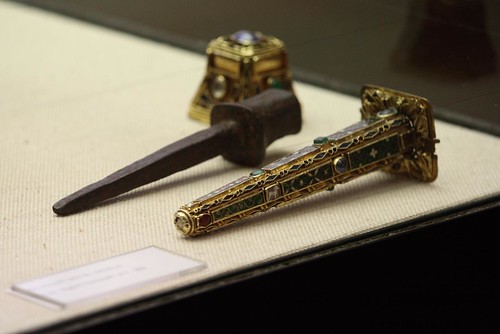
Above is the Holy Nail and its beautiful medieval reliquary, displayed in the Cathedral Treasury of Trier, Germany. It is said to be one of the spikes that nailed Jesus to the cross. (The above photo was published in an article on Christian relics in Saturday's edition of the Wall Street Journal!)
The Holy Nail was a very important relic in medieval Trier. It was carried in processions, used for swearing oaths, and is reported to have healed several blind people during one of its exhibitions.
Trier was an important city in Roman times, and Constantine's mother Helena had an imperial palace here. She is credited with finding many relics of Christ in Jerusalem (most famously the True Cross) and preserving them for veneration.
Also venerated at Trier Cathedral is the Holy Robe (Heilig Rock) that Jesus wore during the Crucifixion. It is kept inside a huge glass reliquary in a fenced-off chapel and only displayed on very special occasions.

Photos and information about the Holy Robe posted on the way to the chapel.
Another church known for its relics is the Basilica of Santa Croce in Gerusalemme (Holy Cross in Jerusalem) in Rome, built next to another imperial palace of St. Helena.

A full-sized replica of the Shroud of Turin in Santa Croce. The head can be seen in the center, with legs to the left.

Also at Santa Croce, an inscribed piece of wood that is said to be the "King of the Jews" sign placed over Christ's cross during the Crucifixion. (Unfortunately quite blurry - this was taken in our early photography days in 2006.)

The Column of the Flagellation (to which Jesus was tied while being whipped before the Crucifixion) in the Church of Santa Prassede, Rome.
This column is said to have been brought from Constantinople by the papal legate Giovanni Colonna, titular cardinal of Santa Prassede, in 1223. Its authenticity is highly doubtful: the marble and work is of too high quality and there is a more realistic version in the Church of the Holy Sepulchre in Jerusalem.
But regardless of its authenticity, the column provides pilgrims a focus for contemplation on the suffering and victory of Christ - as do all the relics and places associated with this central Christian holiday.


No comments:
Post a Comment